Rapid Prototyping
Creating porous graphene on tape for neurons
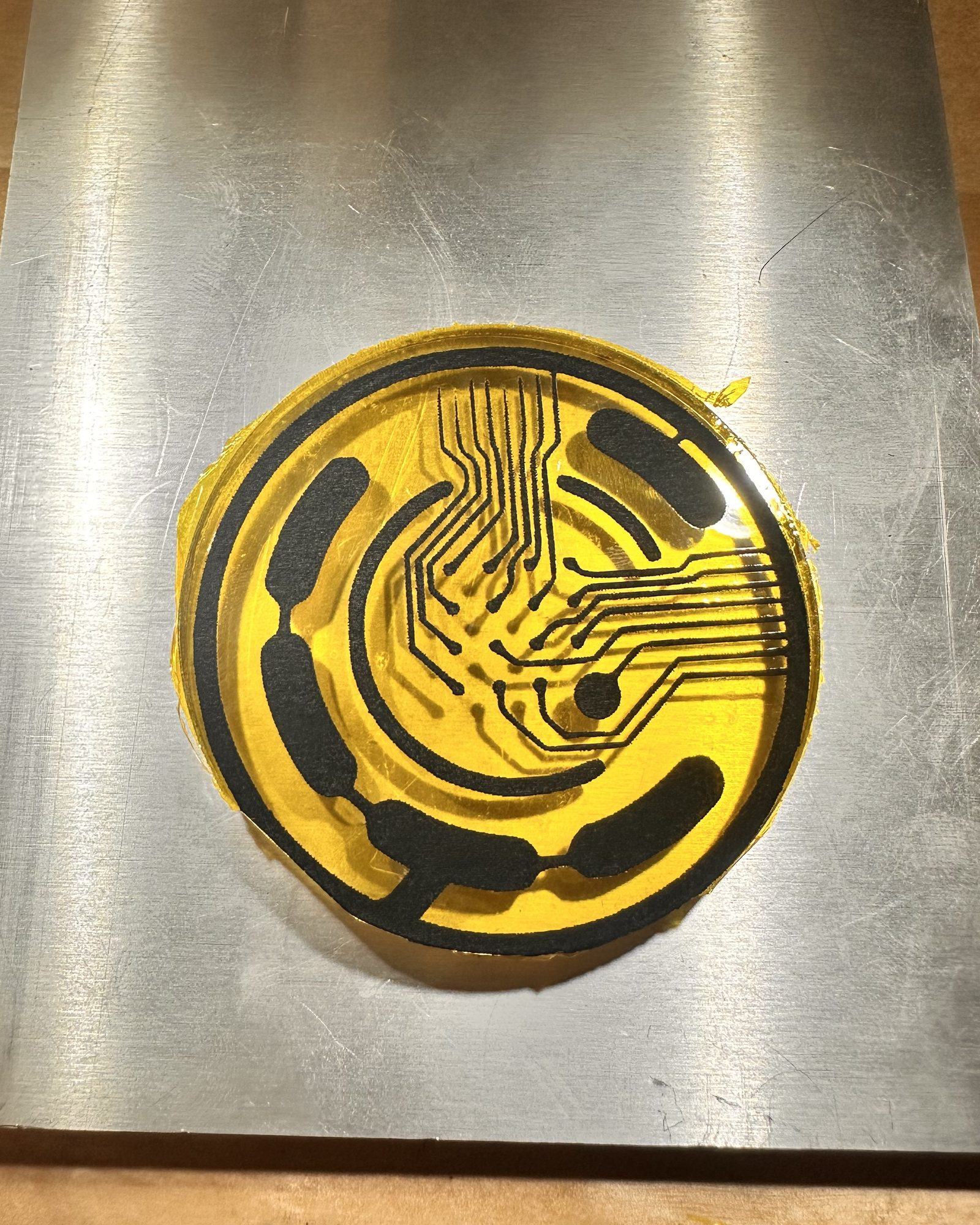
The chips used to record from neurons are made in cleanrooms. In a one-day experiment, Lucy Moglia and I tested whether a desktop laser could draw that wiring directly into Kapton tape instead. It produced a circular pattern of graphene lines that conduct electricity.

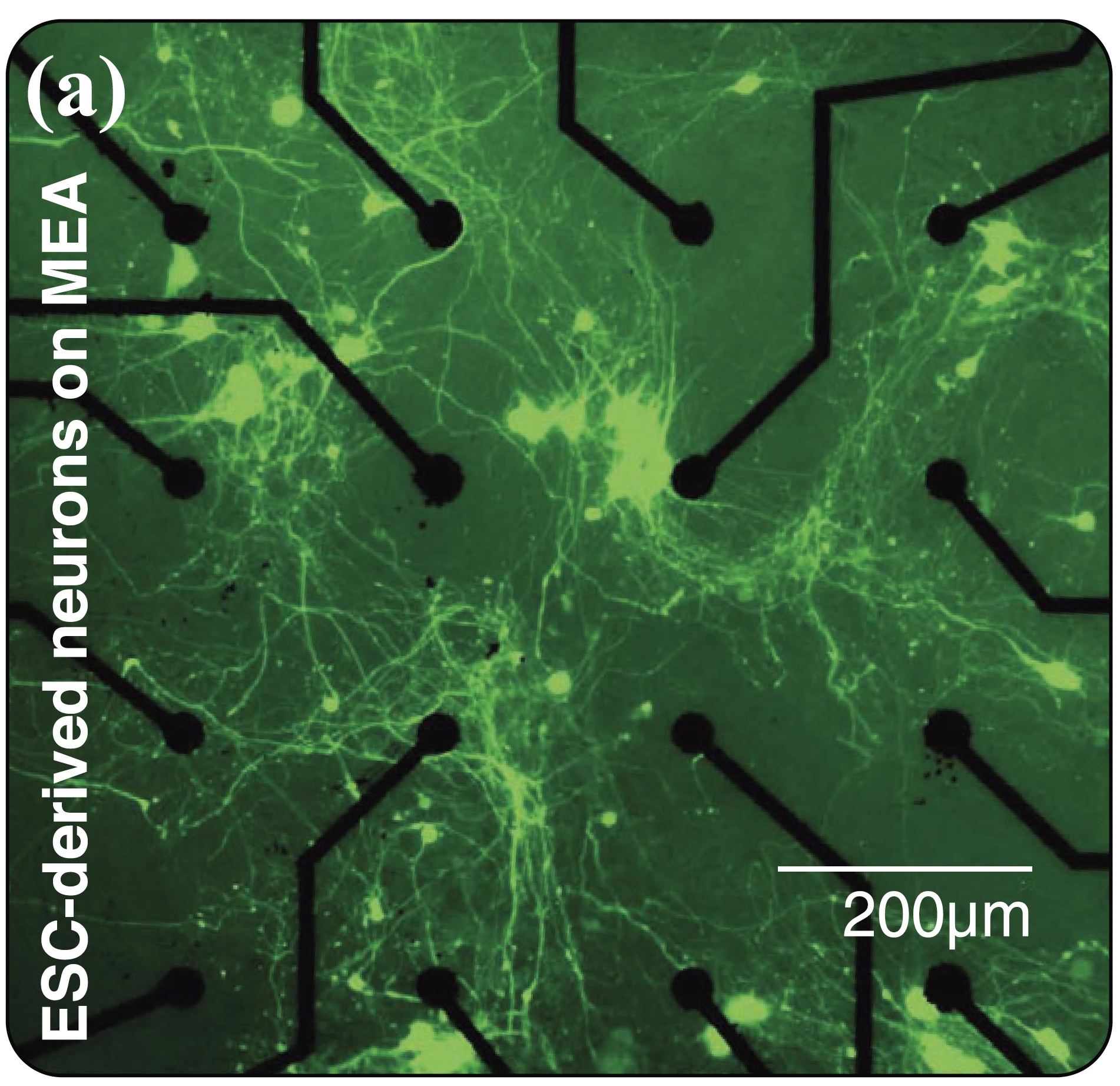
Researchers grow neurons directly on top of an array
To listen to neurons, researchers grow them on a microelectrode array (MEA). Each black dot below is a contact point, and each black line is a wire carrying that point’s signal out to recording equipment. These chips are made in cleanrooms, even the open-source ones (Zhang et al., 2024). Our pattern borrows the same layout of dots and wires, arranged in a circle.
Where the laser hits Kapton, the surface turns to graphene
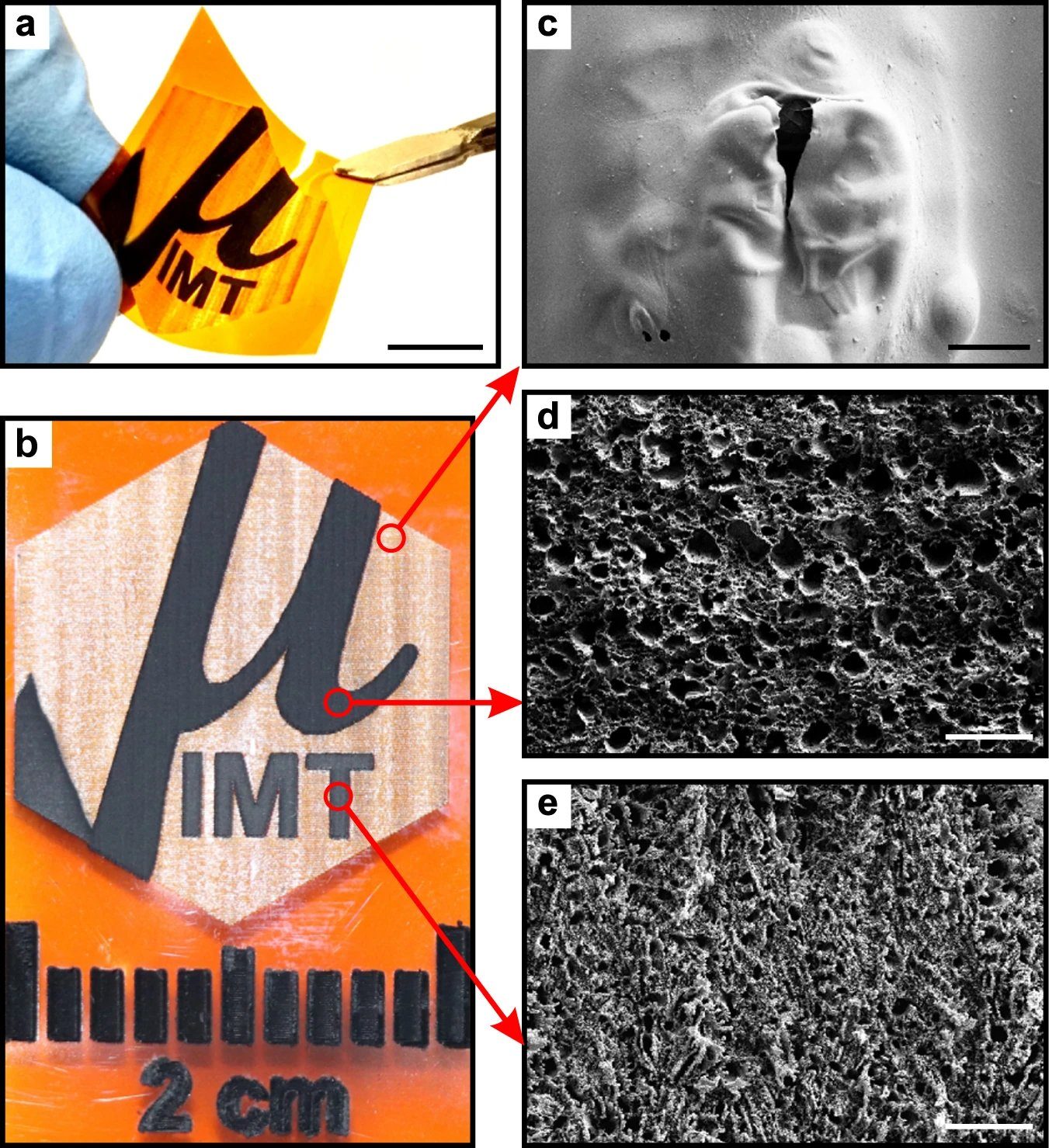
Kapton is a thin, heat-resistant plastic film, usually sold as orange tape. Under a strong enough laser, its surface turns into porous graphene: a spongy form of carbon that conducts electricity (Lin et al., 2014). That lets a laser draw wires straight into the film, with no ink or metal. Too little power only bleaches the film; enough turns it black (Fig. 03b).
We cut the backing on one laser and drew on another
We cut clear acrylic pieces on an xTool laser cutter and stuck Kapton tape on top, so the film would lie flat. The patterns themselves were drawn on a desktop fiber laser.

Before drawing the circle, we tested laser settings
We ran a grid of test lines at power levels from 5% to 25% and speeds from 15 to 100 mm/s. The number beside each group of lines is its power setting. We chose 20% power at 50 mm/s for the circle.

The final pattern: thin graphene wires that conduct
Two bundles of thin wires run in from the edge of the circle, each wire ending in a small round contact point near the center. A multimeter continuity check showed the lines conduct electricity.
The laser drew wires that conduct
What the day showed
- A desktop fiber laser turned Kapton film into porous graphene lines.
- We could succesfully draw a circular array pattern in one piece, and its lines conduct electricity.
Next process idea
A working array also needs metal contacts placed exactly on top of the graphene lines, and lining up two separate processes is hard. While experimenting, we noticed that the same fiber laser, with its pulse shape tuned (a feature called MOPA), could fire through the Kapton and vaporize metal underneath. If that works reliably, the wires and the metal could both be made on one machine, already lined up.